
PART ONE: THE ANOMALY
THE
GRAVITATIONAL PLANT
I was expecting a highly developed
technological civilization, but to my surprise, it was only a dense, rocky
planet, tidally locked to a fading star. I asked the starship for a second
choice, but the answer was negative.
"The choice is correct."
The ship-symbiote's presence resonated in my mind—not as sound, but as pure
understanding, a concept forming in my consciousness before words could shape
it. "The civilization is here. The criteria of your request are met."
I stared at the visual field the
ship projected into my awareness. The star barely registered against the
backdrop of the galactic core—a white dwarf, a stellar cinder that cast less
light than a full moon back on Earth. I would later designate it Vesper, from
the Latin for "evening," a star in the evening of its life.
The planet itself was a monster. My
instruments measured surface gravity at 4.8 G—nearly five times Earth's
crushing pull. Atmospheric pressure read 90 bar, equivalent to being 900 meters
underwater. The surface temperature hovered barely above freezing. Landing
would be impossible. Even approaching a low orbit would subject the ship to
tidal forces it couldn't withstand.
The disappointment was familiar. How
many times had I walked into a room full of people who'd already decided what I
was capable of before I'd opened my mouth? I had spent my life proving them
wrong.
And now, here, staring at what
appeared to be a dead world, the universe itself seemed to be playing the same
tired joke.
"The criteria are not
met," I transmitted back, frustration rising through the neural link.
"This is a tomb, not a civilization. There are no radio signals. No
lights. No electromagnetic emissions of any kind. There is nothing."
"Your assumption is
incorrect," the ship replied with the infinite patience of a being that
had crossed the galaxy a thousand times. "You are looking for signals you
recognize. You are not seeing the signal that is. Directing your
attention."
The visual field shifted. It wasn't
simply visual anymore—the ship overlaid thermal signatures, gravimetric
variations, deep subsurface radar scans, and spectroscopic analysis into a
single unified perception.
And then I saw it.
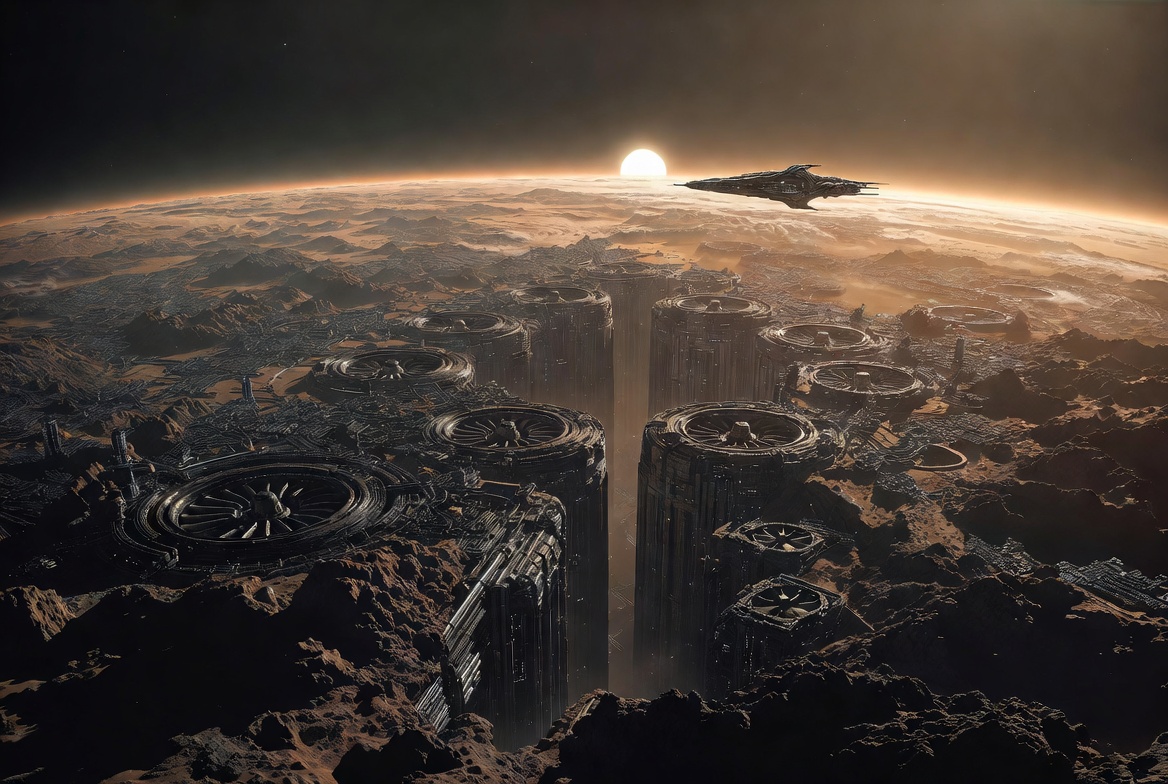
My mind couldn't process it at first. The scale was too vast, the implications too staggering. The entire planet—the entire planet—was a machine.
From pole to pole, sunk kilometers deep into the crust, was a network of structures so immense they defied human scale. I was seeing continent-sized mechanisms, cycling in a slow, powerful, planet-wide rhythm. Massive vertical shafts plunged through the crust. Enormous turbine chambers dotted the surface like mechanical craters. A web of conduits thick as mountain ranges connected them all.
"That's impossible," I whispered aloud, though there was no one to hear me but the ship.
But even as I said it, something else stirred in me. Recognition.
I had seen this pattern before.
The brilliant mind dismissed because of where they came from. The exceptional work overlooked because it came from the wrong source. The achievement invisible because the observers couldn't see past their own assumptions.
"It is not impossible," the ship replied, its analysis flowing into my consciousness. "They are using the planet's own gravity as their engine. It is a buoyancy-based hydro-energy system of remarkable sophistication. They split a compound—analysis suggests water—at the base of deep shafts. The hydrogen, being extremely buoyant in their dense atmosphere, rises through vertical channels. The buoyant force of this rising gas spins turbine generators throughout its ascent. At the surface, the hydrogen is recombined with oxygen in fuel cells, generating additional power and reconstituting the original water. This heavy fluid then falls back down through parallel shafts—falling with 4.8 times the force it would on Earth—spinning hydro-turbines on its descent."
My mind couldn't process it at first. The scale was too vast, the implications too staggering. The entire planet—the entire planet—was a machine.
From pole to pole, sunk kilometers deep into the crust, was a network of structures so immense they defied human scale. I was seeing continent-sized mechanisms, cycling in a slow, powerful, planet-wide rhythm. Massive vertical shafts plunged through the crust. Enormous turbine chambers dotted the surface like mechanical craters. A web of conduits thick as mountain ranges connected them all.
"That's impossible," I whispered aloud, though there was no one to hear me but the ship.
But even as I said it, something else stirred in me. Recognition.
I had seen this pattern before.
The brilliant mind dismissed because of where they came from. The exceptional work overlooked because it came from the wrong source. The achievement invisible because the observers couldn't see past their own assumptions.
"It is not impossible," the ship replied, its analysis flowing into my consciousness. "They are using the planet's own gravity as their engine. It is a buoyancy-based hydro-energy system of remarkable sophistication. They split a compound—analysis suggests water—at the base of deep shafts. The hydrogen, being extremely buoyant in their dense atmosphere, rises through vertical channels. The buoyant force of this rising gas spins turbine generators throughout its ascent. At the surface, the hydrogen is recombined with oxygen in fuel cells, generating additional power and reconstituting the original water. This heavy fluid then falls back down through parallel shafts—falling with 4.8 times the force it would on Earth—spinning hydro-turbines on its descent."
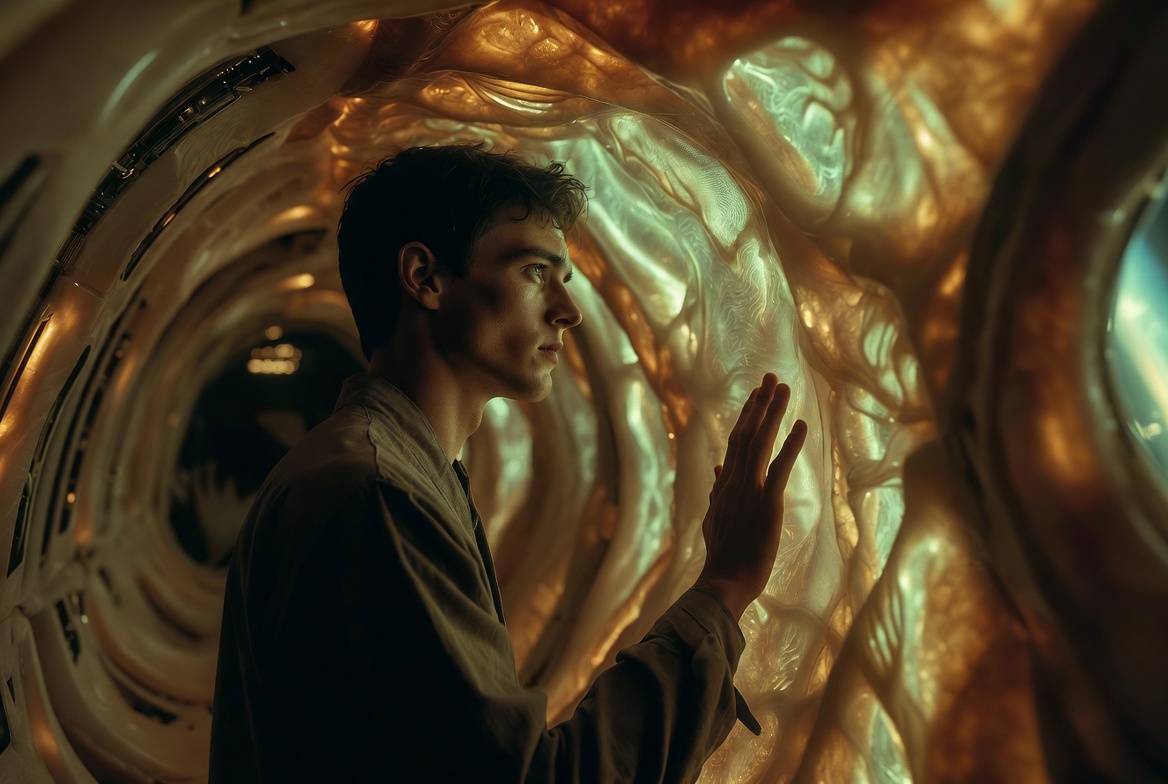
The ship paused, and if a living starship could express awe, I felt it then.
"It is a closed-loop gravitational energy extractor. They have turned their high gravity from a prison into a power source. The system generates 2.4 terawatts of continuous power. The efficiency is... remarkable."
I pulled back from the scan, my hands—physical hands in my physical body aboard this living ship—trembling slightly. The readings scrolled through my awareness. Terawatt-scale power generation. Constant. Stable. Elegant. And completely invisible unless you knew how to look for it.
"Who built this?" I asked, my voice barely audible.
"A people trapped by their gravity," the ship answered.
"No," I said slowly, certainty building like an equation solving itself in my mind.
"A people who turned their prison into their power source. They didn't wait for rescue. They didn't beg for recognition. They just... survived. And created something impossible while doing it."
I stared at the dark world below, seeing it differently now. Not a tomb. Not a failure. A civilization that had adapted, endured, and engineered their way through conditions that should have killed them.
A people who had been dismissed by the universe itself.
I understood them already.
My disappointment had vanished, replaced by a deep, sudden awe. Who were they? How had they built this marvel on a world that crushed everything? And why—the question that would haunt me—why had they needed to?
The ship waited patiently as I processed, as I stared at that impossible planet-machine turning in the darkness.
Finally, I found my voice again.
"I need to know everything," I said. "Their history. How they came to be here. Why they built this. Everything."
"The analysis will take time," the ship cautioned.
"I have time," I replied.
But even as I said it, I knew I was lying. Because something in me—some instinct honed by years of being overlooked, dismissed, underestimated—told me that time was exactly what they didn't have.
That this miracle of engineering wasn't a triumph.
It was a last stand.