Sci-Fi novels
Collection: The Third End Saga
My writings here are the result of ideas I had long ago but was unable to publish because of my limited ability to write in English. Today, with the help of Claude, ChatGPT, Gemini, Grok, Mistral, and Meta, which have rigorously checked facts and helped me express my ideas in plain English, this work is brought to you.
The Reliquians
Chapter One: The Reading
Forty generations of pressure had taught Vora-Sen's family how to listen to the plant.
Listening was the wrong word in any language she could imagine. Sound did not travel here in the way the old books said it had once travelled on Origo, before. Pressure made everything thick. Voices were vibrations through the floor, slow and patient, more felt than heard. But Vora-Sen had been taught the word listening by her grandmother, who had been taught it by hers, and so on back to the generation that still remembered what air had been.
So she listened.
The chamber she worked in was domed and small, carved into the bedrock at the third regulator level, a quarter-kilometre below the surface. The walls pulsed faintly with the bioluminescent moss her ancestors had bred to provide light without drawing power the plant needed elsewhere. The light was green-gold and steady — the colour of patience. Around the chamber, in a continuous arc, the instruments hummed: pressure gauges keyed into the great vertical shafts, flow indicators reading the rise of hydrogen and the fall of water, temperature monitors that measured the thermal cycle of the fuel cells.
The instruments did not speak. They glowed.
A column of soft amber light, two segments wide, meant the upper return shaft was operating within tolerance.
A column of pale violet meant the cathode array at depth was emitting steadily.
A column of low red — never seen in Vora-Sen's lifetime, never seen in her mother's — would mean something had gone catastrophically wrong.
She made her circuit slowly. Movement under this much gravity was always slow. Her eight legs articulated in their habitual rhythm: three lifted, five planted at any moment, a gait her species had refined over two hundred million years of weight. The chitinous plates of her carapace clicked softly against the floor stones. She did not hurry. Hurrying was for beings who could afford to fall.
At each instrument she paused, lowered her body, set the soft sensory tendrils beneath her thorax against the floor. The plant spoke through the ground. She felt the great turbines in the lower shaft — their rotation a deep, slow thrum the floor transmitted into her body. She felt the water cycle, heavier on the descent, lighter on the rise. She felt the fuel cells at the top of the system, distant, faint, a high-frequency shiver you had to be still to detect.
Everything was within tolerance.
She moved on.
This was her shift. This was every shift. Forty generations of Vora-Sens — though they had not all been called Vora-Sen; the names changed every three or four generations, drifting through the language as language itself drifted — had stood in this chamber or one very like it, and listened to the plant, and confirmed that everything was within tolerance. Forty generations had reported nothing wrong. The plant had not failed. The plant did not fail. The plant was the only thing on this world that did not fail, and the people who tended it were the people who had been chosen, generation by generation, to ensure that nothing ever changed.
Vora-Sen did not love her work. She did not hate it. The work was the world.
Her daughter, Tem-Sen, was six cycles old and had just begun her training — learning the instruments, the names of the columns of light, the discipline of stillness. Tem-Sen was today with Vora-Sen's sister, because Tem-Sen had a fever. A small fever, the kind a child could carry through a shift, but Vora-Sen had wanted her near family rather than in the apprentice chamber alone. The fever would pass. Tem-Sen would resume training in two cycles.
Vora-Sen had thought of her daughter twice already this shift. Both times it had taken her a long beat of breathing to put the thought down.
She completed her first circuit. She began her second.
The pressure gauge keyed into the upper return shaft glowed steady amber, two segments wide.
The flow indicator for the descent shaft flickered.
She paused.
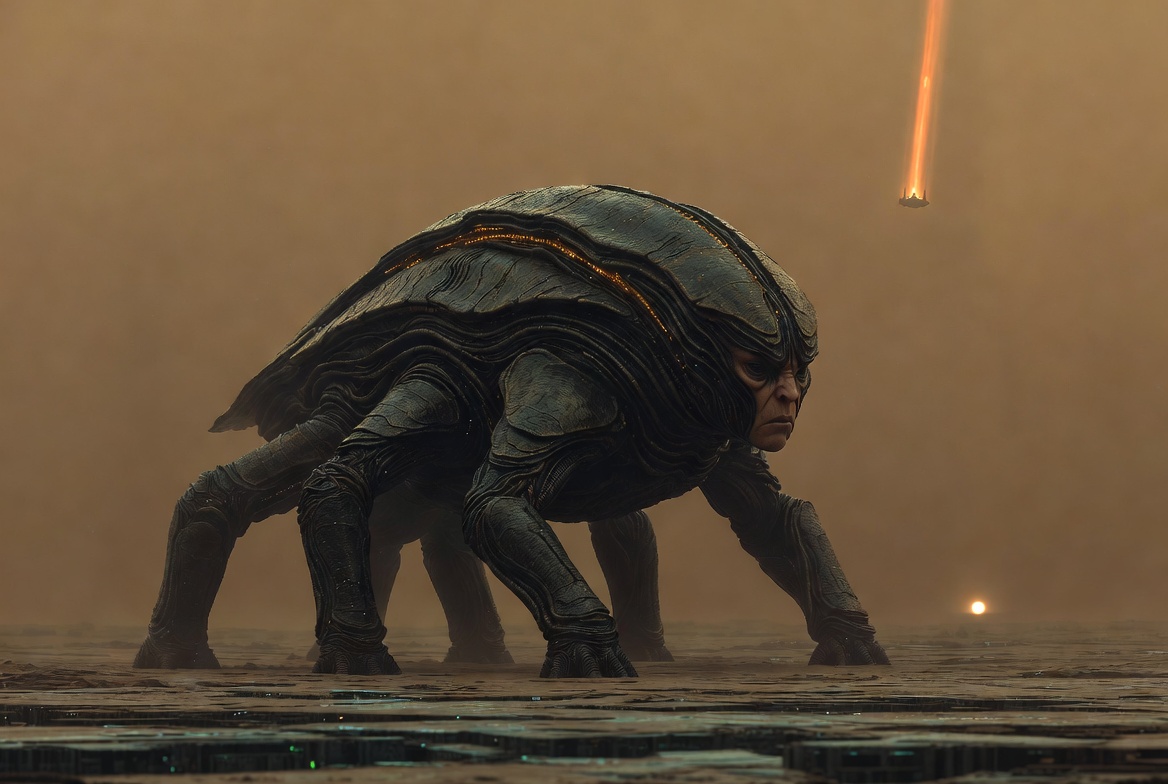
She had not seen the flow indicator flicker in her life. The instruments did not flicker; they shifted, smoothly and slowly, as the cycle adjusted. A flicker was a different motion. A flicker was the instrument reporting that its reading had moved faster than the slow cycle should allow.
She set her sensory tendrils against the floor.
The descent shaft was running at normal weight. The water was falling at the standard cubic flow rate. There was no internal disturbance.
She straightened her body — slowly, a movement that took her three full breaths — and watched the indicator.
It did not flicker again.
After a long time, she made a notation on the chamber's record stone, scoring it with the edge of her foreclaw: Descent indicator flickered, third regulator, mid-shift. Cause undetermined. Self-corrected. She would report it to the chief of the level at shift's end. The chief would report it to the council of the plant. The council would file it in the archive of the plant's operational record, where it would join two hundred million years of similar notations: small anomalies, self-corrected, recorded against the chance that they might one day form a pattern.
She returned to her circuit.
She did not yet think to look up.
There was no reason to look up. Above the chamber was forty metres of bedrock, and above that was the surface — the cold plain of the third terrace, exposed to the thin amber haze of what passed for sky. No one looked up at the sky. The sky was not where anything happened. Things happened in the shafts and the cells and the deep places where the plant did its work.
Vora-Sen returned to the second instrument on her circuit. She paused, lowered her body, set her tendrils against the floor.
And she felt it.
Not in the plant. Not in the turbines or the shafts or the cells.
In the ground, where the plant ended and the bedrock began. A pressure that did not belong to the plant. A vibration that did not match the rhythm of any cycle she had ever felt. Faint. Distant. Above her — yes, she was certain now, above her, in the direction her people had no word for, because nothing came from above.
Something was descending.
She held very still.
The vibration grew.
It was not the plant. It was not seismic activity from the deep crust; she knew that rhythm in her body. It was something moving through the atmosphere — through the ninety-bar weight of air that had crushed every meteor for hundreds of millions of years before it could reach the surface. Something was falling through that atmosphere, and the atmosphere was resisting it, and the resistance was making the bedrock under her sensory tendrils sing in a register she had never been taught to listen for.
She lifted her body. Slowly. As one moved when one did not want to disturb a sleeping child or a fragile machine.
She turned toward the access shaft that led to the surface terrace.
Then she stopped.
In forty generations, no one had been instructed what to do if something fell.
The plant did not have a protocol for the sky.
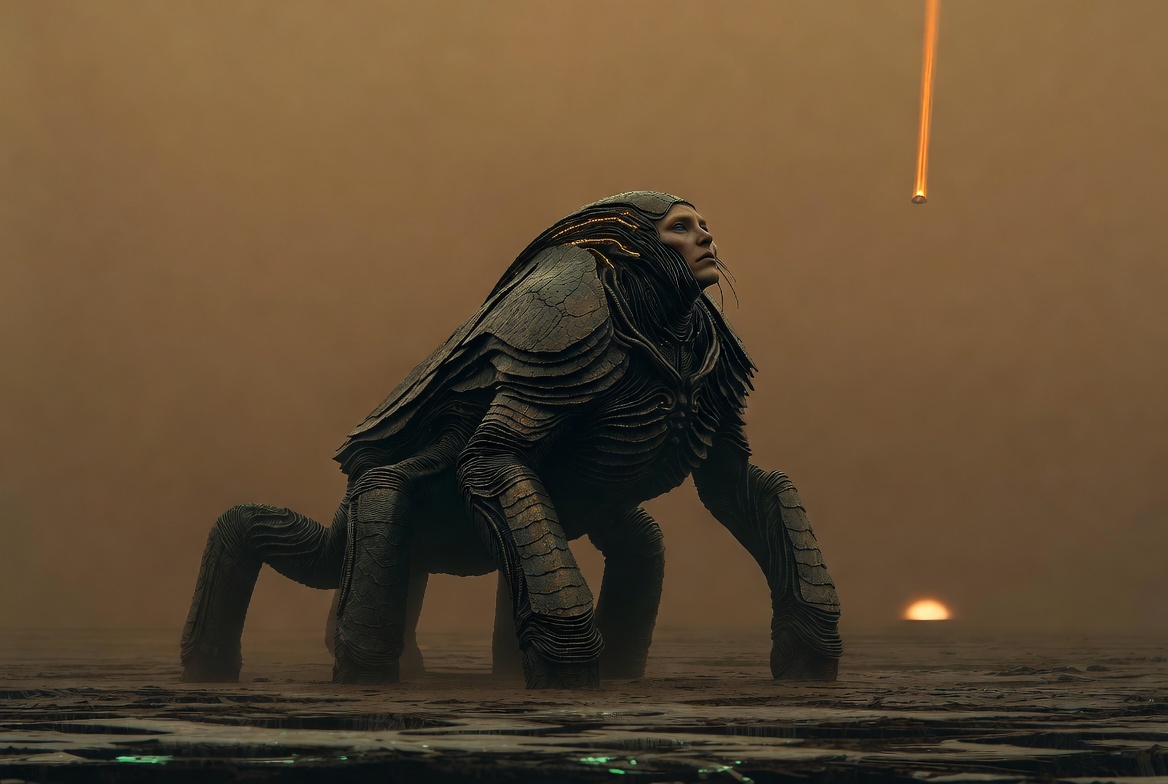
Vora-Sen stood at the centre of the chamber, in the green-gold light of the bioluminescent moss, and listened to the bedrock under her feet sing of something that was not supposed to exist. She thought of her daughter, six cycles old, sleeping under her sister's care with a fever that would pass. She thought of her grandmother, who had taught her the word listening. She thought of the long line of Vora-Sens who had stood in this chamber and confirmed that nothing was wrong.
Something was wrong.
It was not yet a crisis. The plant was unharmed. The cycles continued. Whatever had entered the atmosphere had not reached the ground. It was still falling. It would fall for a long time, in this gravity, through this air.
But it was coming.
And after forty generations of nothing ever changing — after two hundred million years of a civilisation that had survived by ensuring the world remained exactly what it was — something was coming.
She did not yet know to call it a visitor.
She did not yet know that her grandmother's grandmother's grandmother, a hundred generations back, had taken with her into hibernation the hope that someone, someday, would find them.
She only knew that the bedrock under her tendrils was singing, and that she would have to make a notation she had never made before.
She scored the record stone slowly, deliberately, with her foreclaw.
Vibration of unknown origin. Atmospheric. Descending. Recorded by Vora-Sen, regulator third level, this shift. Cause: not yet known.
Then she did something her instructors had never anticipated, and her grandmother's grandmother had never described, and the plant's two-hundred-million-year operational archive had never recorded.
She climbed the access shaft to the surface terrace.
She climbed to where she could see the sky.
When she emerged onto the third terrace, the amber haze hung exactly as it had always hung. The dim disc of Vesper, the white dwarf that had once been her people's sun, sat just above the horizon as it always did, almost too faint to cast a shadow. The wind moved across the metallic plain with its usual slow thickness, lifting nothing, because nothing was light enough here to lift.
She looked up.
She looked, for the first time in her life, at the sky as if something might be in it.
For a long moment she saw nothing.
And then — high, very high, almost too faint for her low-light eyes to register — a single point of brightness, moving against the dim amber, a heat trail blooming behind it.
Falling.
Toward her.
Toward the plant.
Toward the world that had not changed in two hundred million years.
Vora-Sen stood on the third terrace under the amber sky and watched the visitor descend, and the part of her that had been taught by forty generations to ensure that nothing ever changed understood, with a calm that surprised her, that her shift had just become something else.
She did not know what.
She only knew that she should not be alone for this.
She lowered herself toward the access shaft.
She would go and wake her daughter.
The fever would have to wait.
New paragraph